Labels

Showing posts with label Quantitative Aptitude. Show all posts

Wednesday, 29 October 2014

Data interpretation

 Data Interpretation is one of the easy sections of one day competitive Examinations. It is an extension of Mathematical skill and accuracy. Data interpretation is nothing but drawing conclusions and inferences from a comprehensive data presented numerically in tabular form by means of an illustration, viz. Graphs, Pie Chart etc. Thus the act of organising and interpreting data to get meaningful information is Data Interpretation. A good grasp of basic geometric as well as arithmetic formulae is must to score high in this section. Familiarity with graphical representation of data like Venn diagrams, graphs,pie charts, histogram, polygon etc. should be thought. Once the data are grasped well, questions based on tables and graphs take little time.
In some competitive examinations data are presented in more than one table or graphs. The aim is to test not only quantitative skill but also relative, comparative and analytical ability. The crux of the matter is to find a relationship between the two tables or graphs before attempting the questions.
Some Useful tips:
1 . Data Interpretation questions are based on information given in tables and graphs.These questions test your ability to interpret the information presented and to select the appropriate data for answering
a question.
2 . Get a general picture of the information before reading the question. Read the given titles carefully and try to understand its nature.
3 . Avoid lengthy calculations generally, data interpretation questions do not require to do extensive calculations and computations. Most questions simply require reading the data correctly and carefully and putting them to use directly with common sense.
4 . Breakdown lengthy questions into smaller parts and eliminate impossible choices.
5 . Use only the information given and your knowledge of everyday facts, such as the number of hours in a day, to answer the questions based on tables and graphs.
6 . Answer the questions asked and not what you think the questions should be.
7 . Be careful while dealing with units.
8 . To make reading easier and to avoid errors
observe graphs keeping them straight.
9 . Be prepared to apply basic mathematical rules, principles and formulae.
10. Since one of the major benefits of graphs and tables is that they present data in a form that enables you to readily make comparisons, use this visual attribute of graphs and tables to help you answer the questions. Where possible, use your eyes instead of your computational skills.
Tables
Tables are often used in reports, magazines and newspaper to present a set of numerical facts. They enable the reader to make comparisons and to draw quick conclusions. It is one of the easiest and
most accurate ways of presenting data. They require much closer reading than graphs of charts and hence are difficult and time consuming to interpret. One of the main purposes of tables is to make complicated information easier to understand. The advantage of presenting data in a table is that one can see the information at a glance. While answering questions based on tables, carefully read the table title and the column headings. The title of the table gives you a general idea of the type and
often the purpose of the information presented. The column headings tell you the specific kind of information given in that column. Both the table title and the column headings are usually very straight forward.
Graphs
There may be four types of graphs.
1) Circle Graphs: Circle graphs are used to show how various sectors are in the whole. Circle graphs are sometimes called Pie Charts. Circle graphs usually give the percent that each sector receives In such representation the total quantity in question is distributed over a total angle of 360°. While using circle graphs to find ratios of various sectors, don't find the amounts each sector received and then
the ratio of the amounts. Find the ratio of the percents, which is much quicker.
2) Line Graphs: Line graphs are used to show how a quantity changes continuously. If the line goes up, the quantity is increasing; if the line goes down, the quantity is decreasing; if the line is horizontal, the quantity is not changing.
3) Bar Graphs: Given quantities can be compared by the height or length of a bar graph. A bar graph can have either vertical or horizontal bars. You can compare different quantities or the same quantity
at different times. In bar graph the data is discrete. Presentation of data in this form makes evaluation of parameters comparatively very easy.
4) Cumulative Graphs : You can compare several catagories by a graph of the cumulative type. These are usually bar or line graphs where the height of the bar or line is divided up proportionally among different quantities.

I.Bar Graph:
A. If the expenditure of Company A in 2004 is Rs 36 lakhs, then what is its income in that year?
(1) 42 lakhs       (2) 48 lakhs        (3) 54 lakhs         (4) 60 lakhs           (5) 75 lakhs
B. If the income of Company A in 2002 and expenditure of Company B in the same year is equal to Rs 60 lakhs then what is the difference between their net profit in 2002?
(1) 6 lakhs         (2) 8 lakhs          (3) 10 lakhs        (4) 12 lakhs          (5) None of these
C. If the income of Company A in 2001 and income of Company B in 2005 is Rs 50 lakhs and Rs 80 lakhs respectively then the profit gained by Company A in 2001 is how much percent more than that of the profit gained by Company B in 2005?
(1) 62.5%          (2) 67.5%           (3) 82.5%             (4) 87.5%             (5) 75%
 D. Ratio of expenditure to income of Company B in 2004 is how much percent more than that of ratio of expenditure to income of Company A in 2005?
(1) 10%            (2) 20%              (3) 30%               (4) 40%                 (5) 50%
E. If income of Company A in 2006 is Rs 75 lakhs then what is the expenditure of Company B in the same year?
(1) 60 lakhs       (2) 75 lakhs       (3) 90 lakhs         (4) 87.5 lakhs        (5) None of these

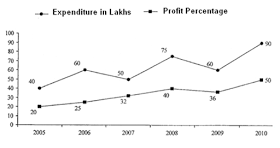
Line chart: Following line graph shows the expenditure and percentage profit of a company of 2005 to 2010.
F. What is the ratio of income in 2008 and 2010?
(1) 5 : 6            (2) 6 : 7             (3) 7 : 8              (4) 8 : 9                (5) 7 : 9
G. In which year amount of profit is minimum?
(1) 2005           (2) 2006           (3) 2007             (4) 2008                (5) 2009
H. What is the percentage rise in amount of profit gained by Company from 2007 to 2008?
(1) 27%            (2) 36%           (3) 44%              (4) 62.5%             (5) 87.5%
I. Expenditure of Company in year 2008 is how much percent more than that of expenditure in 2006?
(1) 15%            (2) 20%           (3) 25%              (4) 27.5%              (5) 30%
J. Income of Company in 2005 in what percentage of income of Company in 2010?
(1) 200/3%      (2) 279/5%       (3) 105/2%         (4) 403/9%            (5) 320/5%

Table: The table given below gives the number of days worked by employees of five grades A, B, C, D and E in different departments.

K. The number of days worked in HR department was highest for which grade ?
1) A            2) B         3) C          4) D             5) E
L. The grade which worked least in all departments is ______?
1) Grade E in IT                                     2) Grade B in HR                         3) Grade B in Software
4) Grade D in IT                                    5) Grade B in Accounts
M. What is the average of working days in IT department?
1) 305              2) 300             3) 296                4) 292                     5) None of these \
N. If average working hours in a day are 8 then the amount of work put by Grade C is
1) 13240        2) 12570          3) 32600        4) 12480              5) 9912
M. If working hours in a day are 8 then average work done (in hours) by Grade A in four departments together is
 1) 1267             2) 2534              3) 2436        4) 1672            5) None of these

Thursday, 16 October 2014

Volume

Volume is the quantity of three dimensional space enclosed by some closed boundary, for example, the space that a substance or shape occupies or contains.Volume is often quantified numerically using the cubic meter. The volume of a container is generally understood to be the capacity of the container, i. e. the amount of fluid (gas or liquid) that the container could hold, rather than the amount of space the container itself displaces.
In geometry, a cube is a three-dimensional solid object bounded by six square faces, facets or sides, with three meeting at each vertex.
                              (a is the length of the side of each edge of the cube)
     Volume of a Cube = a*a*a

rectangular prism:
                                               (a, b, and c are the lengths of the 3 sides)
         Volume of a Rectangular Prism = a*b*c

 A cylinder is one of the most basic curvilinear geometric shapes, the surface formed by the points at a fixed distance from a given line segment, the axis of the cylinder. The solid enclosed by this surface and by two planes perpendicular to the axis is also called a cylinder.
 
                     ('h' is height of the cylinder and 'r' is the radius of base)  
Volume of a Cyinder = pi*r*r*h 
prism:
                                                           ( 'h' height and 'b' base area ) 

Volume of a prism = b*h

 In geometry, a pyramid is a polyhedron formed by connecting a polygonal base and a point, called the apex. Each base edge and apex form a triangle. It is a conic solid with polygonal base. A pyramid with an n-sided base will have n + 1 vertices, n + 1 faces, and 2n edges. All pyramids are self-dual.
                                                      ( 'h' height and 'b' base area )
Volume of a pyramid = 1/3*b*h 
 
A cone is a three-dimensional geometric shape that tapers smoothly from a flat base (frequently, though not necessarily, circular) to a point called the apex or vertex.
                            ( where 'r' radius of the base and 'h' is height)      
   Volume of a Cone = 1/3*pi*r*r*h 

A sphere is a perfectly round geometrical and circular object in three-dimensional space that resembles the shape of a completely round ball. Like a circle, which, in geometric contexts, is in two dimensions, a sphere is defined mathematically as the set of points that are all the same distance r from a given point in three-dimensional space. This distance r is the radius of the sphere, and the given point is the center of the sphere. The maximum straight distance through the sphere passes through the center and is thus twice the radius; it is the diameter.
                                                            (r is radius of circle)
Volume of a Sphere = 4/3*pi*r*r*r

Volume of a ellipsoid = (4/3) pi r1 r2 r3


Surface Areas

Surface Area Formulas In general, the surface area is the sum of all the areas of all the shapes that cover the surface of the object.The surface area of a solid object is a measure of the total area that the surface of an object occupies
In geometry, a cube is a three-dimensional solid object bounded by six square faces, facets or sides, with three meeting at each vertex.
                         (a is the length of the side of each edge of the cube)
 Surface Area of a Cube = 6*a*a
in words, the surface area of a cube is the area of the six squares that cover it. The area of one of them is a*a. Since these are all the same, you can multiply one of them by six, so the surface area of a cube is 6 times one of the sides squared.

Rectangular prism:
                               (a, b, and c are the lengths of the 3 sides)
Surface Area of a Rectangular Prism = 2ab + 2bc + 2ac
In words, the surface area of a rectangular prism is the area of the six rectangles that cover it. But we don't have to figure out all six because we know that the top and bottom are the same, the front and back are the same, and the left and right sides are the same.The area of the top and bottom (side lengths a and c) = a*c. Since there are two of them, you get 2ac. The front and back have side lengths of b and c. The area of one of them is b*c, and there are two of them, so the surface area of those two is 2bc. The left and right side have side lengths of a and b, so the surface area of one of them is a*b. Again, there are two of them, so their combined surface area is 2ab.
 
Surface Area of Any Prism
                                            (b is the shape of the ends)
Surface Area of any prism = Lateral area + Area of two ends.where,Lateral area is equal to the perimeter of shape b * L.in generally,
Surface Area = (perimeter of shape b) * L+ 2*(Area of shape b)

A sphere is a perfectly round geometrical and circular object in three-dimensional space that resembles the shape of a completely round ball. Like a circle, which, in geometric contexts, is in two dimensions, a sphere is defined mathematically as the set of points that are all the same distance r from a given point in three-dimensional space. This distance r is the radius of the sphere, and the given point is the center of the sphere. The maximum straight distance through the sphere passes through the center and is thus twice the radius; it is the diameter.
                                                               (r is radius of circle)
Surface Area of a Sphere = 4 pi* r *r

A cylinder is one of the most basic curvilinear geometric shapes, the surface formed by the points at a fixed distance from a given line segment, the axis of the cylinder. The solid enclosed by this surface and by two planes perpendicular to the axis is also called a cylinder.
                            (h is the height of the cylinder, r is the radius of the top)
Surface Area of a Cylinder = 2 pi* r*r+ 2 pi* r* h
Surface Area = Areas of top and bottom +Area of the side = 2(Area of top) + (perimeter of top)* height = 2(pi r*r ) + (2 pi r)* h
In words, the easiest way is to think of a can. The surface area is the areas of all the parts needed to cover the can. That's the top, the bottom, and the paper label that wraps around the middle.
You can find the area of the top (or the bottom). That's the formula for area of a circle (pi r 2 ). Since there is both a top and a bottom, that gets multiplied by two.The side is like the label of the can. If you peel it off and lay it flat it will be a rectangle. The area of a rectangle is the product of the two sides. One side is the height of the can, the other side is the perimeter of the circle, since the label wraps once around the can. So the area of the rectangle is (2 pi r)* h.Add those two parts together and you have the formula for the surface area of a cylinder.
Surface Area = 2(pi r 2 ) + (2 pi r)* h

A cone is a three-dimensional geometric shape that tapers smoothly from a flat base (frequently, though not necessarily, circular) to a point called the apex or vertex.
Surface area of the cone = pi*r*r + pi*r*l
In words,the lateral surface area of a right circular cone is pi*r*l where 'r' is the radius of the circle at the bottom of the cone and 'l' is the lateral height of the cone (given by the pythagorean theorem l= square root of (r*r+h*h)where h is the height of the cone). The surface area of the bottom circle of a cone is the same as for any circle, pi*r*r.

In geometry, a pyramid is a polyhedron formed by connecting a polygonal base and a point, called the apex. Each base edge and apex form a triangle. It is a conic solid with polygonal base. A pyramid with an n-sided base will have n + 1 vertices, n + 1 faces, and 2n edges. All pyramids are self-dual.
The surface area of a pyramid is A=B+(P*L)/2 where B is the base area, P is the base perimeter and L is the slant heightl= square root of (r*r+h*h) where h is the pyramid altitude and r is the radius of the base.

Areas and Perimeters

Area is simply defined as the size of a surface.Area is the quantity that expresses the extent of a two-dimensional  figure or shape, in the plane. The amount of space inside the boundary of a flat (2-dimensional) object such as a triangle or circle.
A perimeter is a path that surrounds a two-dimensional shape. The word comes from the Greek peri (around) and meter (measure). The term may be used either for the path or its length - it can be thought of as the length of the outline of a shape. Calculating the perimeter has considerable practical applications. The perimeter can be used to calculate the length of fence required to surround a yard or garden. The perimeter of a wheel (its circumference) describes how far it will roll in one revolution. Similarly, the amount of string wound around a spool is related to the spool's perimeter.
Note: "ab" means "a" multiplied by "b". "a 2 " means "a squared", which is the same as "a" times "a".
Be careful!! Units count. Use the same units for all measurements.

square:In geometry, a square is a regular quadrilateral , which means that it has four equal sides and four equal angles  (90- degree angles, or right angles). Below shown figure is square where,all sides are with length of 'a'.
Area and perimeter of the square is can be calculated by using below formula
                                            Area = a*a
                                    Perimeter = 4a

Rectangle:It can also be defined as a rectangle in which two adjacent sides have equal length and with four equal angles  (90- degree angles, or right angles). Below shown figure is rectangle where,sides are with length of 'a' and breadth 'b'.

     
Area and perimeter of the rectangle is can be calculated by using below formula
                                            Area = a*b
                                    Perimeter = 2(a+b)
 
parallelogram: In Euclidean geometry, a parallelogram is a (non self-intersecting) quadrilateral  with two pairs of parallel sides. The opposite or facing sides of a parallelogram are of equal length and the opposite angles of a parallelogram are of equal measure. The congruence of opposite sides and opposite angles is a direct consequence of the Euclidean Parallel Postulate and neither condition can be proven without appealing to the Euclidean Parallel Postulate or one of its equivalent formulations. The three-dimensional counterpart of a parallelogram is a parallelepiped.
 Area and perimeter of the parallelogram is can be calculated by using below formula
                                            Area =b*h
                                    Perimeter = 2(a+b)

In Euclidean geometry, a convex quadrilateral with at least one pair of parallel sides is referred to as a trapezoid in American and Canadian English but as a trapezium in English outside North America. The parallel sides are called the bases of the trapezoid and the other two sides are called the legs or the lateral sides (if they are not parallel; otherwise there are two pairs of bases)
trapezoid = h/2 (b 1 + b 2 )
 Area and perimeter of the trapezoid is can be calculated by using below formula
                                            Area =(b1+b2)*h/2
                                    Perimeter = 2(b1+b2)

A circle is a simple shape of Euclidean geometry that is the set of all points in a plane that are at a given distance from a given point, the centre. The distance between any of the points and the centre is called the radius. It can also be defined as the locus of a point equidistant from a fixed point.
A circle is a simple closed curve which divides the plane into two regions: an interior and an exterior. In everyday use, the term "circle" may be used interchangeably to refer to either the boundary of the figure, or to the whole figure including its interior; in strict technical usage, the circle is the former and the latter is called a disk.
A circle can be defined as the curve traced out by a point that moves so that its distance from a given point is constant.
A circle may also be defined as a special eclipse in which the two foci are coincident and the eccentricity is 0, or the two-dimensional shape enclosing the most area per unit perimeter, using calculus of variations.
Area and perimeter of the circle is can be calculated by using below formula ( pi = 3.14)
                                            Area = pi*r*r
                                    Circumference = 2*pi*r or pi*d

An ellipse is a curve on a plane surrounding two focal points such that a straight line drawn from one of the focal points to any point on the curve and then back to the other focal point has the same length for every point on the curve. As such, it is a generalization of a circle, which is a special type of an ellipse that has both focal points at the same location. The shape of an ellipse (how 'elongated' it is) is represented by its eccentricity, which for an ellipse can be any number from 0 (the limiting case of a circle) to arbitrarily close to but less than 1.

Area and perimeter of the ellipse is can be calculated by using below formula
                                            Area = pi*r1*r2
                                    Perimeter =

A triangle is a polygon with three edges and three vertices. It is one of the basic shapes in geometry. A triangle with vertices A, B, and C is denoted \triangle ABC.
perimeter of the any triangle is can be calculated by using below formula
                  Perimeter = a+b+c

In an equilateral triangle all sides have the same length. An equilateral triangle is also a regular polygon with all angles measuring 60°.
 Area of equilateral triangle:                                                                           
                                     
In an isosceles triangle, two sides are equal in length. An isosceles triangle also has two angles of the same measure; namely, the angles opposite to the two sides of the same length; this fact is the content of the isosceles triangle theoram, which was known by Euclid. Some mathematicians define an isosceles triangle to have exactly two equal sides, whereas others define an isosceles triangle as one with at least two equal sides.The latter definition would make all equilateral triangles isosceles triangles. The 45–45–90 right triangle, which appears in the tertrakis square tiling, is isosceles.
.'.Area of isosceles triangle = 1/2*(b*h)

In a scalene triangle, all sides are unequal, and equivalently all angles are unequal. An equilateral triangle has the same pattern on all 3 angles, an isosceles triangle has the same pattern on just 2 angles, and a scalene triangle has different patterns on all angles since no angles are equal.
The shape of the triangle is determined by the lengths of the sides. Therefore the area can also be derived from the lengths of the sides.
 By Heron's formula:A=√s(s-a)(s-b)(s-c) ( square root for whole terms)
where 'S' equal to (a+b+c)/2 is the semiperimeter, or half of the triangle's perimeter.

Tuesday, 7 October 2014

Number System

n this first article of our topic ‘Numbers’, we deal with ‘Numbers’ themselves. What are numbers ? Where do we see and meet them ? Are they of different types ? Can we learn these distinct types ?
Well, numbers are all around us, floating all over the place. They demand our attention and careful evaluation. A number here or there can make a huge difference. In face a misplaced zero or decimal is the difference between one being poor or rich. Such being their importance, it is critical we begin with the most basic concepts in Mathematics: types of numbers.
 In Hindu Arabic System, we use ten symbols 0, 1, 2, 3, 4, 5, 6, 7, 8, 9 called digits to represent any number. This is the decimal system where we use the numbers 0 to 9. '0'  is called insignificant digit.
Types of Numbers
  • Natural numbers
  • Whole numbers
  • Integers
  • Positive Integers
  • Negative Integers
  • Non-negative Integers
  • Rational Numbers
  • Irrational Numbers
  • Real Numbers
  • Even Numbers
  • Odd Numbers
  • Prime Numbers
  • Composite Numbers 
-Natural numbers : Counting numbers 1, 2, 3, 4, 5... are known as natural numbers. The set of all natural numbers can be represented by N= {1, 2, 3, 4, 5...}
-Whole numbers : If we include 0 among the natural numbers, then the numbers 0, 1, 2, 3, 4, 5 ... are called whole numbers.The set of whole number can be represented by W= {0, 1, 2, 3, 4, 5...}. Every natural number is a whole number but 0 is a whole number which is not a natural number.
-Integer : All counting numbers and their negatives including zero are known as integers.
The set of integers can be represented by Z or I = {...-4,-3,-2,-1, 0, 1, 2, 3, 4 ...}
-Positive Integers :The set I = {1, 2, 3, 4...} is the set of all positive integers. Positive integers and natural numbers are synonyms.
-Negative Integers : The set I = {-1, -2, -3...} is the set of all negative integers. 0 is neither positive nor negative. Non-negative Integers : The set {0, 1, 2, 3...} is the set all non-negative integers.
-Rational Numbers : The numbers of the form p/q, where p and q are integers and q ≠ 0, are known as rational numbers, e.g. 4/7, 3/2, -5/8, 0/1, -2/3, etc. The set of all rational numbers is denoted by Q. i.e. Q ={x:x =p/q; p, q belong to I,q≠0}. Since every natural number ‘a’ can be written as a/1, every natural number is a rational number. Since 0 can be written as 0/1 and every non-zero integer ‘a’ can be written as a/1, every integer is a rational number. Every rational number has a peculiar characteristic that when expressed in decimal form is expressible rather in terminating decimals or in non-terminating repeating decimals. For example, 1/5 =0.2, 1/3 = 0.333...22/7 = 3.1428704287,
 8/44 = 0.181818...., etc. The recurring decimals have been given a short notation as 0.333.... = 0.3
4.1555... = 4.05, 0.323232...= 0.32.
-Irrational Numbers : Those numbers which when expressed in decimal from are neither terminating nor repeating decimals are known as irrational number, e.g. √2, √3, √5, Ï€, etc.
Note that the exact value of is not 22/7. 22/7 is rational while π irrational number. 22/7 is approximate value of π. Similarly, 3.14 is not an exact value of it.
-Real Numbers : The rational and irrational numbers combined together are called real numbers, e.g.13/21, 2/5, -3/7;√3, 4 +√2, etc. are real numbers.The set of all real numbers is denoted by R.
Note that the sum, difference or product of a rational and irrational number is irrational, e.g. 3+√2, 4 -√3, 2/3-√5, 4√3,-7√5 are all irrational.
-Even Numbers : All those numbers which are exactly divisible by 2 are called even numbers.
e.g.2, 6, 8, 10, etc., are even numbers.
-Odd Numbers : All those numbers which are not exactly divisible by 2 are called odd numbers, e.g. 1,3, 5, 7 etc., are odd numbers.
-Prime Numbers : A natural number other than 1 is a prime number if it is divisible by 1 and itself only. For example, each of the numbers 2, 3, 5, 7 etc., are prime numbers. 2 is the only even number which is prime number. Two numbers which have only 1 as the common factor are called co-relatively prime to each other, e.g. 3 and 5 are co-primes.
Prime numbers up to 100 are: 2, 3, 5, 7, 11, 13, 17, 19,23, 29, 31, 37, 41,43, 47, 53, 59,
61, 67, 71, 73, 79, 83, 89, 97, i.e. 25 prime numbers between 1 and 100.
-Composite Numbers : Natural numbers greater than 1 which are not prime, are known as composite
numbers. For example, each of the numbers 4, 6, 8, 9, 12, etc., are composite numbers. The number 1 is neither a prime number nor composite number.

Some more properties on natural numbers  :
  • Sum of 1st n Natural number i.e 1 + 2 + 3 + …. + n = {n (n + 1)} /2
  • Sum of squares of 1st n natural number i.e { n(n+l)(2n+l) }/6
  • Sum of cubes of 1st n Natural number i.e  [{n(n+1)}/2]^2
  • Sum of squares of 1st n Odd natural number i.e {n (2n -1 )(2n + 1)}/3
  • Sum of squares of 1st n Even natural number i.e {2n(n+1)(2n+1)}/3
  • Sum of cubes of 1st n Odd natural number i.e  n^2 (2n^2 -1)
  • Sum of cubes of 1st n Even natural number i.e  2 [n (n + 1)]^2  
Let’s consider any digit (Say 2) and check how many times it appears in different ranges
  • From 1 – 9, the digit 2 is used 1 time
  • From 1 – 99, the digit 2 is used 20 times.
  • From 1 – 999, the digit 2 is used 300 times
  • From 1 – 9999, the digit 2 is used 4000 times and so on
This is a generalization we can use for any number between 1 to 9. So in case a question asks you how many 3s between 1 to 99, you can simply say 20. How did we arrive at this conclusion?
Well, there are two series of three’s here: 3, 13,…33,…93 = ten 3s at the unit’s place. 30,31…39= ten 3s at the ten’s place. So a total of 20 threes make an appearance here.

6 when multiplied with 7 give 4 and 2
6 x 7 = 42
66 x67 = 4422
666 x 667 = 444222
6666 x 6667 = 44442222
For multiplication such as the above : The number of digits in both the numbers is same , the 2nd number has one 6 less than the number of  6’s the 1st number has . The number of 4’s and 2’s is equal to the number of 6’s in the 1st number

Cyclic numbers
142857 is called as the cyclic number, since its digits are rotated around when multiplied by any number from 1 to 6
142857 x 1 = 142857
142857 x 5= 714285
142857 x 4= 571428
142857 x 6 = 857142
142857 x 2= 285714
142867 x 3 = 428571

Magical 1
3 x 37 = 111
33 x 3367 = 111,111
333 x 333667 = 111,111,111
3333 x 33336667= 111,111,111,111
33333 x 3333366667= 111,111,111,111,111
333333 x 333333666667 = 111,111,111,111,111,111
Consider the L.H.S of the above numbers. The number of 3s in both the numbers are same and 6 is one less than the number of 3 and there is only one 7. Then in the final product, N would appear three times the number of threes in the first number on the LHS.

Some Other Properties of Numbers
Squares: There is a definite relationship between the unit digits when square of a number is considered, we  will see that one by one.
If unit digit of a perfect square is I then ten’s digit has to be Even (e.g. 81, 121, 441 etc)
If unit digit of a number is 2 then it can’t be a perfect square.
If unit digit of a number is 3 then it can’t be a perfect square.
If unit digit of a perfect square is 4 then ten’s digit has to be Even (e.g. 64,144 etc)
If unit digit of a perfect square is 5 then ten’s digit has to be 2 (e.g. 25, 225, 625 etc)
If unit digit of a perfect square is 6 then ten’s digit has to be Odd and multiple of 3.
If unit digit of a number is 7 & 8 then it can’t be a perfect square
If unit digit of a perfect square is 9 then ten’s digit has to be Even (e.g. 49, 169 etc)
If unit digit of a perfect square is 0 then ten’s digit has to be 0 (e.g. 100,400,900 etc)
Hence if a number end with 2, 3, 7 or 8 then it can’t be perfect square.
Properties of Integers :  We have studied about integers, the entities which can be shown on the number line is called integers there are some properties of Integers in Nature. Usually these properties are used in the GRE examination
  • Among all the numbers positive and negative whole numbers are included in the integers
  • Zero is neither rational nor irrational but it is an Integer
  • There are some numbers which follow one another which are called as consecutive integers
  • There is an Integer to which a number is multiplied the value will never change and that integer is 1
Order of Operation
As like BODMAS in CAT exam, GRE believes in PEMDAS and this stands for
P = Parentheses
E = Exponents
M= Multiplication
D = Division
A = Addition
S= Subtraction
TOOLTIP 1:   What is the approximate value of N= [{2(4 +5)3 x 4}/10 -23]
Step by step
[{2(9)3 x 4}/10 -23] => [{2(729) x 4}/10 -23] => [{1458 x 4}/10 -23] => [5832/10 -23] => 560.2 = 560 approximate Consecutive Integers: The integers which follow one another are called consecutive integers
For example 3,4,5,6 are consecutive integers. An individual random number never be a consecutive integer.
Some more points about Consecutive Numbers
TOOLTIP 1
If there is odd number of digits in the  set of consecutive numbers like set of three consecutive numbers (4,5,6,) or 5 digits are there say (3,4,5,6,7). Then in this case the sum of all integers always divisible by the number of digits of set
For example 2+3+4 = 9 divisible by number of digits i.e. 3
For example 1+2+3+4+5 = 15 divisible by 5
TOOLTIP 2
On the other hand ,If there is even number of digits in  set of consecutive numbers like set of four consecutive numbers (4,5,6,7) or 6 digits are there say (3,4,5,6,7,8). Then in this the sums of all integers is never be divisible by the number of digits of the set
For example 2+3+4+5 = 14 never divisible by number of digits i.e. 4
For example 1+2+3+4+5+6 = 21 never divisible by 6

Number systems-II

The concept of fractions, though a simple one, can be often confused. Having not solved questions based on this simple concept, students often tend to confuse the problems. These questions can throw up the occasional challenge and it makes sense to practice these questions from this area.
Definition : Technically, fraction is defined as part of the whole. The most common example of a fraction that comes to mind is half. When we say give me half of something, we are essentially demanding ½ part of it, in others word, ½ is the fractional representation for half.
Fractions are nothing else than the numerator divided by denominator, that is they occur in the form X/Y where X is the numerator and y is the denominator.
Remember : The numerator represents how many parts of that whole are being considered. To remember simply, numerator is the top number of the fraction that represents the numbers of that that are to be chosen. The denominator represents the total number of parts created from the whole, in other words it is the bottom number representing the total number of parts created.
Example of Fractions : ½,2/3,3/4, and the numbers which are in the form of x/y
Types of Fractions:
Proper Fraction: When Numerator < Denominator, then the fraction is called as proper fraction. For example: 2/3, 4/5, 6/7 etc.
Improper fractions: When Numerator > Denominator, then the fraction is called as improper fraction. For example: 5/3, 7/5, 19/7 etc.
Mixed Numbers: when a natural number combines with a fraction that is called a mixed number. For Example: 21/2 ,34/etc
Tool tip 1: Basic Applications of Fractions 1. Fraction help us determine the part of any number ¾ part of 56 = ¾ x 56 = 42, 4/5 part of 90 = 4/5 x 90 =24
2. You can be asked to represent a number in the form of fraction. For example, you can be asked to represent 15 as a fraction of 450. This can be done as follows: 15/450 = 1/30
We have solved the above example and it can be easily seen that 15 is our numerator and 450 is our denominator
3. Always remember that the major quantity from which we have to extract something is the denominator. For example, when we say 4/5, we are essentially extracting four parts out of five.
4. Extending the above concept, the quantity which is extracted is our numerator
Example: 15/450 = 1/30
15 is the numerator because we have extracted 15 from 450 and the denominator is 450 because 15 is extracted from 450 so we can say that 1/30th part of 450 is 15
Tool tip 2: Properties of fractions
Property 1: If we multiply the numerator and denominator by same quantity, the basic value of fraction will never change.  For example: 4/5 x 5/5 = 20/25 = 4/5
Property 2: If there are two fractions a/b and c/d then a/b=c/d when ad=bc. For example 3/4 = 12/16 because 3 x 16 = 4 x 12
Property 3: A fraction with zero as the denominator is not defined.
Property 4: If the numerator of the fraction is zero, then the fraction equals zero.
Property 5: If the numerator and denominator of the fraction are equal, then the fraction is equal to one.
DECIMALS
Are all numbers integers? Well, the obvious answer to that question is a no. All numbers are not integers. Consider the case of 0.333333. What is this number? An integer? Well, it is a decimal. But wait are decimals? Decimals are nothing else but the values lying between two integers on the number line.
Remember the following decimal forms (showcasing how decimals look like on either side of the number line):
Decimals less than -1: -12.12, -9.13, -1.2 (the numbers are arranged in increasing order with -1.2 being the largest among all).
Decimals between -1 and 0: -0.52, -0.40, -0.04
Decimals between 0 to 1: 0.12, 0.14, 0.80
Decimals greater than 1: 2.13, 5.64, 7.83
Relating decimals to fraction: When we solve a fraction of the p/q form, it is not necessarily it would return an integral value.  When we left with a remainder, we ultimately convert it into decimal form. Some examples of Decimals are 4.5, 9.6, 6.78, and 99.98 , these all are decimal numbers 
Tool tip 1: Forming Decimals from Fractions
How we can write 4/5 in decimal form?
Since the number 4 is smaller than the 5, so the decimal value will be less than one. Multiple and divide both numbers by 10. We have: 40/ (10×5) Which effectively is (dividing the 40 by 5 first)
8/10. Thus, the final result is 0.8 So 4/5 = 0.8. 0.8 is the decimal form.
Tool tip 2: Adding Decimals While adding decimals, you should always write the decimals in a vertical column with the decimal points aligned vertically.
Add all these 0.567 +78+8.9+5.06+56
= 78.000 +  56.00 +   5.06   +  0.567 =  139.627
Tool tip 3: Subtracting Decimal
In addition we can write the numbers in any order. But while subtracting, we should preferably write the numbers in descending order and the vertical column with decimal points should be aligned to the same decimal points.
Let’s take an example: we have to subtract 5.06 from 0.567. We write it as: 5.06 - 0.567 = 5.507
This result is wrong because in case of subtraction we need equal digits in both the quantities, so these blank spaces filled with 0. So this can be done like as 5.060 - 0.567 =  4.493
This is the right approach for the question
Tool tip 4: Multiplying Decimals
As a first step, multiply the given integers in the normal form keeping the decimals aside.  The number of decimal places in the product is then equal to the total of the decimal places in the two decimals. It is as simple as that.
Consider the following example : 5.060 X 0.567  = 2.869020
First multiply 5060 with 567 and get the result as 2869020 and then move the decimal point to 6 places from the left, that is between 2 and 8. Effectively, we move it to six decimals places, our sum total of the decimal places in the two numbers.

cyclicity : 
 type 1 : where power of single digit is considered
The concept of cyclicity is used to identify the last digit of the number which is in the form of power like pk. Let’s take an example to understand this:
Example 1 :  find the unit digit of 356.
Solution :  Now it’s a big term so we cannot find the last digit by doing 3 x 3 x 3 x 3 x 3……. 56 times so we use the concept of cyclicity
Step 1 : 31 = 3
32 = 9
33 = 27
34 = 81
35 = 243
So now pay attention to the last digits we saw that the last digit repeats itself after a cycle of 4 and the cycle is 3 ,9,7,1,this is called the cyclicity of any number ,therefore when we need to find the unit digit of any number like 3n we just need to find the number on which the cycle of last digit ends .  And in the next step we will divide the power with the cyclicity

  • if the remainder will be 1 then the unit digit will be 3
  • if the remainder will be 2 then the unit digit will be 9
  • if the remainder will be 3 then the unit digit will be 7
  • if the remainder will be 0 then the unit digit will be 1
This is all about the cyclicity
Why the power is divided by number 4.
We will divide the power with 4 because cycle repeat itself after 4 values, and also we need to find the remainder which tells us the required values to complete the next cycle.
Now the main question was that how much is the last digit of 354
So we know the cycle repeats itself after 4 so we will divide the 54 with 4 ,so on dividing 54 by 4 the remainder becomes 2 .Now as we discussed above if the remainder is 2 the last digit would be 9, so in the end the unit digit of 354 is 9.
Type 2 :  where power of 2 and 3 digits number is to be considered
Example 2 : What will be the unit digit of 2445 or 34745
Solution : Lets take some example to understand it very clearly
We know that unit digit of 3 x 3 = 9
And the unit digit of 453 x 543 = 9
The main purpose of the above expression is that the unit digit of any multiplication depends upon the unit digit of numbers , whatever is the number big or small the unit digit always depends upon the multiplication of the last digit .
So the last digit of 2445 can be found by 445
So the cyclicity of 4 is 2 because the cycle of last digit repeats after two values
41 = 4
42 =16
43 = 64
So when we divide 45 with 2 then we will get the remainder as 1 and the last digit will be 4
Now come to the case number second unit digit of 34745
The unit digit of this number can be find by the same method
The cyclicity of 7 is  4
71  = 7
72 = 49
73 = 343
74 = 2401
So on dividing 45 with 4 , 1 will be the remainder and the last digit would be 7
Type 3 : where pqr is to be considered
What will be the last digit of 122345
To find the last digit of this type of number we  will start the question from the base the base is 12. It means we will see the cyclicity of 2 because the last digit is depends upon the unit digit of 12. Lets do it step vise step
Before the steps we will write the last digits of
21 = 2
22 = 4
23 = 8
24 = 6
25 = 2
Step 1: Now we know that cyclicity of last digit of 12 i.e 2 is 4 , hence the divide the power of 12 i.e 2345  with 4
Step 2:  Now the remainder 2345 /4 will determine the last digit.
Step 3:  The remainder will be 3 because we can write remainder of 23 /4 = 3 or -1 and -1 45 / 4 will give us remainder as -1 or 3
Hence in the end the last digit of 122345 is nothing but 123  =  8.
How to find unit digit of a number :
For the concept of identifying the unit digit, we have to first familiarize with the concept of cyclicity. Cyclicity of any number is about the last digit and how they appear in a certain defined manner. Let’s take an example to clear this thing:
The cyclicity chart of 2 is:
21 =2
22 =4
23 =8
24=16
25=32
Have a close look at the above. You would see that as 2 is multiplied every-time with its own self, the last digit changes. On the 4th multiplication, 25 has the same unit digit as 21. This shows us the cyclicity of 2 is 4, that is after every fourth multiplication, the unit digit will be two.
Cyclicity table:
The cyclicity table for numbers is given as below:
Number     Cyclicity
1                   1
2                  4
3                  4
4                  2
5                  1
6                  1
7                  4
8                  4
9                  2
10                1

How did we figure out the above?
Multiply and see for yourself. It’s good practice. Now let us use the concept of cyclicity to calculate the Unit digit of a number.
What is the unit digit of the expression  445?
Now we have two methods to solve this but we choose the best way to solve it i.e. through cyclicity
We know the cyclicity of 4 is 2
Have a look:
41 =4
42 =16
43 =64
Here the 4 comes again to the end when the 4 raised to the power of 3 so it is clear that the cyclicity of 4 is 2.  Now with the cyclicity number i.e. with 2 divide the given power i.e. 45/2 what will be the remainder the remainder will be 1 so the when remainder was 1 what was the answer when 4 raised to the power one see first step , yes , 4
So the unit digit in this case is 4.
For checking whether you have learned the topic, think of any number like this, calculate its unit digit and then check it with the help of a calculator.
Lets solve another example:
The digit in the unit place of the number 795 X 358 is
A.  7
B.  2
C.  6
D.  4
Solution
The Cyclicity table for 7 is as follows:
71 =7
72 =49
73 = 343
74 = 2401
Let’s divide 95 by 4: the remainder is 3.
Thus, the last digit of 795 is equals to the last digit of 73 i.e. 3.
The Cyclicity table for 3 is as follows:
31 =3
32 =9
33 = 27
34 = 81
35 = 243
Let’s divide 58 by 4, the remainder is 2. Hence the last digit will be 9.

Monday, 6 October 2014

Percentage

Percentage means for every hundred. The symbol % must be replaced by a fraction 1/100. A percentage must be expressed as a fraction or a decimal.this concept is developed to make the comparison fractions easier by equalising the denominators of all fractions to hundred.
 for example, 7/11 as percentage is represented as 7/11 = 63.63%
Percentages can also be re[presented as decimal fractions. in such a case it is effectively equivalent to the proportion of the original quantity. for example, 20% is same as 20/100, i.e., 0.2
Any percentage can be expressed as a decimal fraction by dividing the percentage figure by 100 and conversely, any decimal fraction can be converted to percentage by multiplying it by 100.
Percentage Increase or Decrease of a quantity is the ratio expressed in percentage of the actual Increase or Decrease of the quantity to the original amount of the quantity, i.e.,
  • Percentage Increase = ( Actual Increase/Original quantity )*100
  • Percentage Decrease = ( Actual Decrease/Original quantity )*100
For example, if the production of rice went up from 225 MT in 1994, then the percentage increase in rice production from 1993 to 1994 is calculated as follows:
Actual increase = 242 -225 = 17 MT
Percentage increase = ( Quantity increase from 1993 to 1994/Actual production of rice in 1993 )*100
= 17/225 * 100 = 7 5/9%
Ratio of any two quantities can be expressed as percentage. for example, if the ratio of A and B is 3:2, we can say the ratio of A : Bis 60% : 40%.
Whenever there is any percentage increase or decrease on a quantity, we can directly calculate the new value of the quantity instead of calculating the actual increase/decrease and then adding to/ subtracting from the original quantity. for example, if the increase on a value of 350 is 15%, the new quantity is 1.15 * 350 = 402.5 (where 1.15 = 1+0.15, 0.15 being the decimal equivalent of 15% )
If the production in 1994 is given as 400 MT and the increase from 1993 to 1994 is given to be 25%, then the production in 1993 will be equal to 400/1.25 = 320 MT. similarly, if there is a decrease of 12% on a quantity of 225, then the new quantity will be equal to 225*0.88 (where 0.88 = 1-0.12, 0.12 being the decimal equivalent of 12% )
On the basis of percentage increase, we can write down how many times the old value gives the new value. for example, if the percentage increase is 100%, then we can conclude that the new value is 2 times the old value. if the percentage increase is 300%, the new value is 4 times the old value. if the percentage increase is 450%, then the new value is 5.5 times the old value. in general, if the percentage increase is p%, then the new value is (p/100 + 1) times the old value.
conversely, if we know how many time the old value gives the new value, we can find out the new percentage increase in the old value to get the new value. for example, if the new value is 3 times the old value, the percentage increase in the old value to get the new value is 200%. if the new value is 4.25vtimes the old value, then the percentage is 325%. in general, if the value is k times the old value, then the percentage is (k-1)*100.
Examples
1. The number of tourists visiting a country increased by 80% from 1990 to 1991. from 1991 to 1992, there was a 50% increase. find the percentage increase in the number of tourists visiting the country from 1990 to 1992.
Solution: Let the number of tourists visiting the country in 1990 be 100. As the number of visitors increased by 80% from 1990 to 1991, the number of visitors increased by 80% of 100 i.e., 80. Hence, the number of visitors will be 180 in 1991. then, there was 50% increase from 1991 to 1992. this country will be 180 + 90 (50% of 180) = 270. so the number  of tourists to the country went up from 100 to 270 in 1992, an increase of 170 from the initial number of tourists of 100. hence the percentage increase = ( increase/initial )*100 = 170/100*100 = 170%.
=>In general, if there are successive increases of p%, q% and r% in three stages, the effective percentage increase is {(100+P/100)(100+Q/100)(100+R/100) - 1}*100.
If one or more of p, q and r decrease percentage figures and not increase percentage, then it will be taken as a negative, then it will be taken as a negative figure and not as a positive figure.similarly, if the resultant figure is negative, it means it is a net decrease.the same can be extended to any number of successive increase or decrease percentages.

2. The ratio of salaries of mehata and dixit is 20:21, by what percentage is 20:21. By what percentage is dixit's salary greater than that of mehata ?
Solution: The given ratio is 20:21. This means, the salary of dixit is 21 parts when the salary of mehata is 20 parts. Percentage by which Dixit's salary is greater than Mehta's
 = (21-20)/20*100 = 5%.

3. If the price of an item goes up by 10%, by what percentage should the new price be reduced to bring it down to the original price ?
Solution : Let the original price be 100. now it becomes 110, due to 10% increase. now, to bring this down to the original price, we have to effect a reduction of 10 from 110. hence percentage reduction 10/110*100 = 9.09%
=> In general, if the value of an item goes down by X%, the percentage increment to be now made it bring it back to the original level is = 100X / (100 - X).  if the value of an item goes up by X%, the percentage reduction to be now made it bring it back to the original level is = 100X / (100 + X).

Percentage Points
the concept of  "percentage points" is important in the usage of percentages. percentage points is the difference of two percentage figures.
Let us understand this with an example. suppose that rice forms 20% of total food grain production in year  the I and 30% of total food grain production in year II. If we asked to find out the percentage increase in the production of rice, calculating percentage increase from 20 to 30 as 30-20/20*100 and saying it is 50% increase is NOT correct. with the available data, we cannot find out the percentage increase in the production of rice from year I to II. wee can only say that the production of rice as a percentage of total food grain production went up by Production Points.
We can see by taking the following figures that the percentage increase in rice production need not be 50%. In year I rice -1000, total food grains - 5000, rice as percentage of total food grains - 20%. similarly, In year I rice -960, total food grains - 3200, rice as percentage of total food grains - 30%.
Here, while the rice is 20% of the total food grains in year I and 30% of total food grains in year II, we find the actual production of rice has not even increased - it decreased from 1000 in year I to 980 in year II.

Sunday, 5 October 2014

Ratio

If the values of two quantities A and B are 4 and 6 respectively, then we say that they are in the ratio 4:6 (read as "four is to six"). Ratio is the relation which one quantity bears another of the same kind, the comparison being made by considering what multiple, part or parts, one quantity is of the other. The ratio of two quantities "a" and "b" is represented as a:b and reads as "a is to b". here, "a" is called antecedent, "b" is the consequent. since the ratio express the number of times one quantity contains the other, it's an abstract quantity.
Ratio of any number of quantities is expressed after removing any common factors that all the terms of the ratio have. For example, if there are two quantities having values of 4 and 6, their ratio is 4:6, i.e., 2:3 after taking the common factor 2 between them out. similarly, if there are three quantities 6,8 and 18, there is a common factor among all three of them. so, dividing each of the term by 2, we get the ratio ass 3:4:9.
If two quantities whose values are A and B respectively are the in the ratio a:b, since we know that some common factor k(>0) would have been removed from A and B to get the ratio a:b, we can write the original values of the two quantities (i.e., A and B) as ak and bk respectively.For example, if the salaries of two persons are in the ratio 7:5, we can write their individual salaries as 7k and 5k respectively.
A ratio a:b can also be expressed as a/b. so if two items are in the ratio 2:3, we can say that their ratio is 2/3. if two terms are in the ratio 2, it means that they are in the ratio of 2, it means that they are in the ratio of 2/1 i.e., 2:1.
"A ratio is said to be ratio of greater or less quantity or of quantity according as antecedent is greater than, less than or equal to consequent". In other words,
- the ratio a:b where a>b is called a ratio of greater inequality (example 3:2)
- the ratio a:b where a<b is called a ratio of less inequality (example 3:2)
- the ratio a:b where a=b is called a ratio of equality (example 1:1)
From this we can find that a ratio of greater inequality is diminished and a ratio of less inequality is increased by adding the same quantity to both terms, i.e., in the ratio a:b, when we add the same quantity x (positive) to both the terms of the ratio, we have the following results
   If a<b then (a+x):(b+x) > a:b
   If a>b then (a+x):(b+x) < a:b
   If a=b then (a+x):(b+x) = a:b
this idea can be helpful in questions on data interpretation when we need to compare fractions to find the larger of two given fractions.
If two quantities are in the ratio a:b , then the first quantity will be a/(a+b) times the total of two quantities and the second quantity will be equal to b/(a+b) times the total of two quantities.

To understand the concept of Ratio, we have to come across the more examples.
Example 1:The sum of two numbers is 84. if the two numbers are in the ratio 4:3, find the two numbers ?
solution: As the two numbers are in the ratio 4:3, let their actual values be 4x and 3x. As the sum of two numbers is 84, we have 4x + 3x = 84,which is equal to 7x = 84. so, x = 12.
Hence, 4x = 48 and 3x = 36.
Alternatively, the two numbers are (4/7)*84 = 48 and (3/7)*84 = 36 i.e., 48 and 36 respectively since the ratio of two numbers is 4:3..

Example 2: If 4a = 3b, find (7a+9b) : (4a:5b) .
Solution: it is given that 4a = 3b, hence, (a/b) = (3/4)
 => a =3k and b=4k, where k is the common factor of a and b. Required expression (7a+9b):(4a +5b)
= [(7*3k)+(9*4k)]:[(4*3k)+(5*4k)] = (21k + 36k) : (12k+20k) = 57k:32k = 57 : 32.

Example 3: The number of red balls and green balls in a bag are in the ratio of 16:7. if there are 45 more red balls than the green balls, find the number of green balls in the bag.
Solution: Since, the ratio of number of red and green balls is 16:7, let the number of red balls and green balls in the bag be 16x and 7x. so, the difference of red and green balls is 9x. 16x-7x = 9x = 45.
That means x =5. Hence, the number of green balls = 7x i.e., 35
Alternatively, 7x = (7/9)*(9x) = (7/9)*(45) = 35. Hence, there are 45 green balls in the bag.

Example 4: What least number must be added to each of a pair of numbers which are in the ratio
7 : 16 . so, that the ratio between the terms becomes 13 : 22 .
Solution : Let the number to be added to each number be a. Let the actual values of the numbers be 7x and 16x, since their ratio is 7 : 16. Given that, (7x+a)/(16x+a) = (13/22)
=> 154x + 22a = 208x + 13a => 9a = 54x.
=> a = 6x. when x =1, a is the least number required and is equal to 6.

Example 5: A number is divided into four parts such that 4 times the first part, 3 times the second part, 6 times the third part and 8 times the fourth part are all equal. in what ratio is number is divided .
Solution: lets the four parts into which the number is divided be a,b,c and d. 4a = 3b =6c = 8d.
Let the value of each of these equal to e. a = e/4, b = e/3, c = e/6, and d = e/8.
Hence, a:b:c:d = e/4 : e/3 : e/6 : e/8 = 6/24 : 8/24 : 4/24 : 3/24.The ratio of the parts into which the number is divided is 6 : 8 : 4 : 3.

Example 6: If x:y = 4:3, y:z = 2:3, find x : y : z ?
Solution: As y is common to both ratios , make y in both ratios equal. this is done by making y have the value equal to the LCM of two parts corresponding to y in the ratios i.e., LCM(3,2) is 6. if y = 6,
x = (4/3) * 6 = 8, z= (3/2)*6 = 9. Hence x : y : z = 8 : 6 : 9.

Example 7: In a mixture of milk and water, ratio of milk to water is 5:1 . if 5 liters of water is added to the mixture, the ratio becomes 5:2. Determine the quantity of milk in mixture initially?
Solution: The ratio of milk and water is 5 : 1. let water and milk are 5k and k. when the k is common factor. (5k +5) / (k + 5) = 5/2. 10k +10  = 5k + 25, k = 3. So the answer is 15 liters of milk is there in the initial mixture of milk and water.


Thursday, 18 September 2014

LOGARITHMS

the logarithm of a number is the exponent to which another fixed value, the base, must be raised to produce that number. For example, the logarithm of 1000 to base 10 is 3, because 10 to the power 3 is 1000: 1000 = 10 × 10 × 10 = 103.The logarithm to base 10 (b = 10) is called the common logarithm and has many applications in science and engineering. The natural logarithm has the irrational (transcendental) number e (≈ 2.718) as its base; its use is widespread in pure mathematics, especially calculus. The binary logarithm uses base 2 (b = 2) and is prominent in computer science.

Some properties of logarithms are given below:
 If a^m = x, then m = loga(x).
 Properties :
 a. logb(b) = 1
 b.logb(1) = 0
 c.logb(mn) = logb(m) + logb(n)
 d. logb(m/n) = logb(m) – logb(n)
 e. logb(m) = 1/logm(b)
 f.  logb(mn) = n · logb(m)
 g.logb(m)= loga(m)/loga(m)
 Logarithms for base 1 does not exist.Remember that, when base is not mentioned,it is taken as 10.
 In less formal terms, the log rules might be expressed as:
    1) Multiplication inside the log can be turned into addition outside the log, and vice versa.
    2) Division inside the log can be turned into subtraction outside the log, and vice versa.
    3) An exponent on everything inside a log can be moved out front as a multiplier, and vice versa.
Warning: Just as when you're dealing with exponents, the above rules work only if the bases are the same. For instance, the expression "logd(m) + logb(n)" cannot be simplified, because the bases (the "d" and the "b") are not the same, just as x2 × y3 cannot be simplified (because the bases x and y are not the same).
Expanding logarithms
Log rules can be used to simplify expressions, to "expand" expressions, or to solve for values. 

Expand log4( 16/x ). I have division inside the log, which can be split apart as subtraction outside the log, so
    log4( 16/x ) = log4(16) – log4(x)
The first term on the right-hand side of the above equation can be simplified to an exact value, by applying the basic definition of what a logarithm is: 
        log4(16) = 2
Then the original expression expands fully as: 
      log4( 16/x ) = 2 – log4(x)
Always remember to take the time to check to see if any of the terms in your expansion (such as the log4(16) above) can be simplified.

Expand the following:   log_2 (8x^4 / 5)
The 5 is divided into the 8x4, so split the numerator and denominator by using subtraction:
         log_2 (8x^4 / 5) = log_2 (8x^4) - log_2 (5)
Don't take the exponent out front yet; it is only on the x, not the 8, and you can only take the exponent out front if it is "on" everything inside the log. The 8 is multiplied onto the x4, so split the factors by using addition:      
       log2(8x4) – log2(5) = log2(8) + log2(x4) – log2(5)
The x has an exponent (which is now "on" everything inside its log), so move the exponent out front as a multiplier: 
        log2(8) + log2(x4) – log2(5)  =   log2(8) + 4log2(x) – log2(5)
Since 8 is a power of 2, I can simplify the first log to an exact value:
       log2(8) + 4log2(x) – log2(5) = 3 + 4log2(x) – log2(5)
Each log contains only one thing, so this is fully simplified. The answer is: 3 + 4log2(x) – log2(5)

some simple problems
A. Solve log2(8) = x.
I can solve this by converting the logarithmic statement into its equivalent exponential form, using The Relationship: 
         log2(8) = x  
         2 x = 8
  But 8 = 23, so:2 x = 23  x = 3
Note that this could also have been solved by working directly from the definition of a logarithm: What power, when put on "2", would give you an 8? The power 3, of course!
If you wanted to give yourself a lot of work, you could also do this one in your calculator, using the change-of-base formula:
             log2(8) = ln(8) / ln(2)
Plug this into your calculator, and you'll get "3" as your answer. While this change-of-base technique is not particularly useful in this case, you can see that it does work. (Try it on your calculator, if you haven't already, so you're sure you know which keys to punch, and in which order.) You will need this technique in later problems.B. Solve log2(x) + log2(x – 2) = 3
I can't do anything yet, because I don't yet have "log equals a number". So I'll need to use log rules to combine the two terms on the left-hand side of the equation: 
                   log2(x) + log2(x – 2) = 3  
                   log2((x)(x – 2)) = 3  
                   log2(x2 – 2x) = 3.Then I'll use The Relationship to convert the log form to the corresponding exponential form, and then I'll solve the result: 
                log2(x2 – 2x) = 3   
               23 = x2 – 2x   
               8 = x2 – 2x  
              0 = x2 – 2x – 8   
              0 = (x – 4)(x + 2)   
               x = 4, –2.But if x = –2, then "log2(x)", from the original logarithmic equation, will have a negative number for its argument (as will the term "log2(x – 2)"). Since logs cannot have zero or negative arguments, then the solution to the original equation cannot be x = –2.so,the solution is 4.
Keep in mind that you can check your answers to any "solving" exercise by plugging those answers back into the original equation and checking that the solution "works":
          log2(x) + log2(x – 2) = 3  
         log2(4) + log2(4 – 2) = 3  
          log2(4) + log2(2) = 3
Since the power that turns "2" into "4" is 2 and the power that turns "2" into "2" is "1", then we have:
           log2(4) + log2(2) = 3  
          log2(22) + log2(21) = 3   
             2 + 1 = 3 ,The solution checks. Copyright © Elizabeth Stapel 2002-2011 All Rights Reserved 
C. Solve log2(log2(x))   = 1.
This may look overly-complicated, but it's just another log equation. To solve this, I'll need to apply The Relationship twice: 
      log2(log2(x)) = 1
       21 = log2(x)  
       2 = log2(x) x = 22   
       x = 4,Then the solution is x = 4.
D. Solve log2(x2)  = (log2(x))2. First, I'll write out the square on the right-hand side: 
log2(x2) = (log2(x))2
log2(x2) = (log2(x)) (log2(x))

Then I'll apply the log rule to move the "squared", from inside the log on the left-hand side of the equation, out in front of that log as a multiplier. Then I'll move that term to the right-hand side:
2log2(x) = [log2(x)] [log2(x)]
0 = [log2(x)] [log2(x)]  –  2log2(x)

This may look bad, but it's nothing more than a factoring exercise at this point. So I'll factor, and then I'll solve the factors by using The Relationship:
0 = [log2(x)] [log2(x) – 2]
log2(x) = 0  or  log2(x) – 2 = 0

20 = x   or  log2(x) = 2

1 = x  or  22 = x

1 = x  or  4 = x

The solution is x = 1, 4.